The KDP Graph Paper Composition Notebook as a Tangible Tool for Modern Planning
In a digital landscape saturated with apps and cloud-based services, the enduring appeal of a physical notebook, specifically one built for precision, is noteworthy. A KDP Graph Paper Composition Notebook represents more than just a product listing on Amazon's Kindle Direct Publishing platform; it is a meticulously designed, ready-to-sell physical artifact tailored for creators who value structure and hands-on planning. For professionals, entrepreneurs, and hobbyists, this notebook serves as a foundational tool, bridging the gap between abstract ideas and concrete, executable plans. Its standardized 5x5 grid provides a uniform canvas, making it an ideal companion in workflows that require measurement, spatial organization, or systematic notation.
Integrating Graph Paper into Core Professional and Creative Workflows
The utility of a graph paper notebook extends across numerous disciplines and stages of project development. Its integration is often seamless because it addresses a common need: the requirement for a controlled space to draft, calculate, and visualize. Unlike blank or lined pages, the grid imposes a gentle structure, aiding precision without constraining creativity.
Preparation and Ideation: The First Stage of Any Project
Before a software developer writes a line of code, an architect designs a building, or a marketer launches a campaign, there is a phase of unstructured ideation and logical planning. Here, a Graph Paper Composition Notebook 5x5 becomes invaluable. The grid allows for sketching wireframes, user interface layouts, or flowchart diagrams with relative scale and alignment. An entrepreneur might use it to map out business process models or financial projections, using the squares to create tidy tables for cost-benefit analysis before any digital spreadsheet is opened. This physical act of drawing forces a clarity of thought that can be lost in the immediacy of digital tools.
During Execution: A Real-Time Companion and Log
As a project moves from planning to active execution, the notebook transitions into a real-time logbook. For educators, it can serve as a space to plot out lesson plans or design classroom layouts. For engineers and DIY enthusiasts, it's perfect for recording measurements, sketching mechanical diagrams, or tracking iterative design changes during a build. The notebook's portability and immediacy—no boot-up time or battery required—make it an efficient tool for capturing ideas, adjustments, and observations on-site or in meetings, complementing digital note-taking apps by serving as a primary, unfiltered source.
Organization and Quality Control: Maintaining Consistency
A key advantage of using a standardized tool like a KDP Graph Paper Composition Notebook is the consistency it brings to documentation. When all sketches, notes, and plans for a long-term project are kept in a uniform format across multiple volumes, reviewing and auditing that work becomes significantly easier. This is crucial for quality control in fields like product design or academic research, where tracing the evolution of an idea is necessary. The physical notebook also acts as a centralized, offline archive, reducing dependency on digital file organization systems and providing a tangible backup.
The Practical Value of a Ready-to-Publish KDP Package
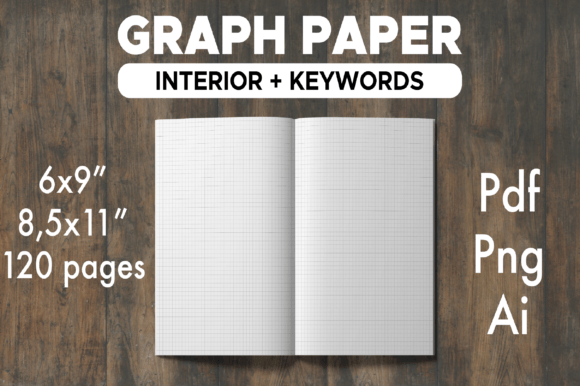
For the audience of creators, publishers, and small business owners, the mention of a downloadable package containing editable source files is particularly significant. This shifts the notebook from being merely a consumable product to a customizable business asset. The provided Adobe Illustrator source file, PNGs, and PDFs represent a complete workflow toolkit for publishing on KDP.
A Streamlined Path from Concept to Marketplace
The typical process for a self-publisher involves designing a book interior, ensuring technical specifications like bleed and dimensions are correct, and preparing files for upload. This package eliminates the most time-consuming and technically fraught steps. By starting with an editable .AI file, a user can:
- Quickly modify the cover or interior page design to match their brand.
- Adjust the graph grid's color or weight for a different aesthetic.
- Add proprietary logos or specific instructional text for specialized niches (e.g., "Electronics Project Notebook").
The included 6x9 inch and 8.5x11 inch PDFs, pre-tested for KDP, mean the core product is already compliant with platform requirements, focusing the user's effort on customization and marketing rather than technical setup.
Compatibility and Usability in a Digital Publishing Workflow
This resource interacts directly with other tools and decisions in a publisher's workflow. The Adobe Illustrator source file requires, naturally, Illustrator or a compatible vector graphics program. This fits into a professional workflow where a creator might also use photo editing software for other projects. The provided PNG files at 300 DPI are ready for use in promotional materials on websites, social media, or other marketing platforms, ensuring visual consistency across the product listing and its advertisements. The inclusion of a PPTX file suggests the assets can also be easily integrated into pitch decks or instructional materials for those selling the notebook as part of a broader service or educational package.
Implementation Tips for Maximizing the Notebook's Utility
To integrate a graph paper notebook effectively, one should consider its role within a broader system of tools.
Dedicate Notebooks to Specific Processes: Instead of using one notebook for everything, assign specific volumes to specific projects or types of work—one for financial planning, one for technical sketches, one for lesson planning. This leverages the notebook's consistency for better archival and retrieval.
Create a Hybrid Digital-Physical System: Use the notebook for initial drafts and on-the-spot calculations. Then, periodically transfer finalized diagrams or data into digital repositories (like a project management tool or CAD software) for sharing, further editing, or backup. The notebook is the initial capture device; digital tools are for distribution and collaboration.
Utilize the Grid for Non-Traditional Tasks: Beyond math and drawing, the 5x5 grid can be used for tracking habits (one square per day), planning content calendars for bloggers, or even practicing calligraphy with consistent letter height. Its structure aids any task requiring regularity.
Long-Term Use and the Role of Physical Tools in Digital Age Productivity
The decision to incorporate a physical graph paper composition notebook into a modern, often digital-centric workflow is a conscious choice for tactile engagement and focused thought. Its long-term value lies in its role as an unplugged, dedicated space for deep work. Unlike a tablet or computer screen filled with notifications and multitasking possibilities, the notebook's interface is singular and purposeful. Over time, a collection of these notebooks becomes a personal or professional library of tangible progress, documenting the journey of projects in a format that is both durable and intuitively navigable.
For the KDP publisher or entrepreneur selling these notebooks, the provided downloadable package represents an optimized starting point. It allows them to enter the marketplace with a professionally formatted product, then iterate and expand their line based on customer feedback or niche discovery, using the same foundational editable assets. This turns the process of selling a simple notebook into a scalable, efficient business operation, perfectly aligned with the practical, execution-minded ethos of its target users.