Master Your Mind: The Automatic Negative Thoughts Record & CBT
Imagine having a tool that pauses the mental noise—the internal critic, the spiral of doubt, the unfounded fears. The Automatic Negative Thoughts Record is exactly that: a structured yet simple method derived from Cognitive Behavioral Therapy. CBT is a gold-standard psychological approach based on the idea that our thoughts, feelings, and behaviors are interconnected. By changing our thoughts, we can change our emotional and behavioral outcomes.
The Automatic Negative Thoughts Record isn't just a diary; it's a targeted intervention. It guides you to identify, dissect, and challenge those fleeting, automatic negative thoughts that often dictate your day. It's interesting because it turns introspection into a clear, almost clinical process. You're not just venting; you're collecting data on your own mind to find the flaws in its logic. This process of creating a record makes the intangible tangible, giving you a concrete worksheet to work with, a battlefield map for your internal struggles.
From Personal Insight to Creative Utility
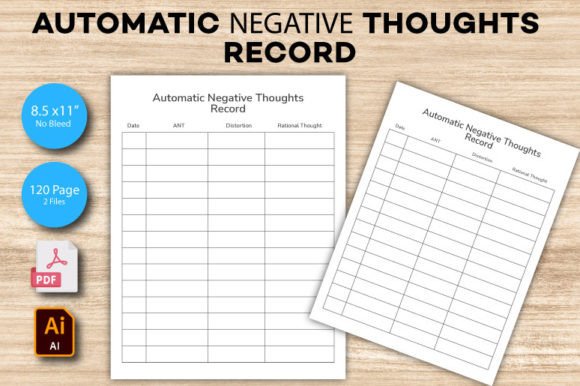
The beauty of the Automatic Negative Thoughts Record lies in its dual nature. It's a profound self-help tool, but its format—a worksheet—also makes it a versatile creative asset. This is where its utility expands beyond the purely therapeutic. For the designer, marketer, or blogger, it becomes a template for content. For the educator or small business owner, it transforms into a curriculum module or a client resource. The structured layout of thought, emotion, evidence, and balanced perspective is a framework that can be adapted endlessly.
Consider the creative possibilities. The core CBT worksheet can be the foundation for a series. You could design a "Morning Anxiety Log" focusing solely on anticipatory thoughts, or a "Social Interaction Analysis" for those navigating social anxiety. The format invites variation in style: minimalist and clean for a professional audience, or illustrated and gentle for younger users or those new to self-reflection. The approach can shift from a strict, evidence-based columnar layout to a more freeform, prompted journaling style that still guides the user through the essential CBT steps.
Adapting the Framework for Diverse Goals
How can different users adapt this tool? A freelance wellness coach might embed the worksheet into a broader client onboarding package, using it to establish a baseline for their work together. An entrepreneur in the mental health space could use it as a lead magnet—a free, high-value printable PDF that demonstrates their expertise and methodology. A publisher might compile a series of these records into a workbook, adding thematic chapters on stress, relationships, or work performance.
The platform dictates the format. For instant digital download, the classic 8.5 x 11 inch PDF is perfect. It's ready for printing at home, a crucial feature for immediate use. The inclusion of a high-resolution JPEG allows for easy embedding in blog posts, social media content, or online course materials. The AI file is the gold for designers—a fully editable vector source that lets you change colors, fonts, and layouts without losing quality, enabling you to brand the worksheet or create entirely new derivatives.
Practical Inspiration: Making the Concept Work
Let's move from theory to application. Imagine you're a blogger focusing on productivity. You could create a variation called the "Procrastination Thought Record." Instead of generic negative thoughts, the columns would prompt the user to identify thoughts like "This task is too overwhelming" or "I'll fail if I start now," then challenge them with evidence of past successes and create a balanced, actionable thought like "I can break this down into three small steps."
For an educator running a student wellness workshop, the worksheet could be simplified. The language might shift from "cognitive distortion" to "thinking trap." The evidence column could become "What facts do I have?" This keeps the results clear and audience-friendly, maintaining the CBT essence while making it accessible. Consistency is key—if you're creating a series, maintain the same logical flow across all worksheets so users build familiarity with the process.
Organizing for Effectiveness and Originality
To keep the results effective, the worksheet must guide without being prescriptive. The prompts should be open enough to allow for personal reflection but structured enough to ensure the CBT model is followed. For instance, the column for "Alternative/Balanced Thought" shouldn't just be a blank line; it could include a gentle prompt: "Given the evidence, what is a more realistic or helpful way to see this situation?"
Originality comes not from altering the core psychology, but from the presentation and context. You might pair the worksheet with a short video tutorial explaining how to use it. Or, design a companion sheet that focuses on the positive—an "Automatic Positive Thoughts Amplifier" to balance the work. The goal is to provide practical guidance that empowers the user. This means avoiding vague instructions like "write your feelings." Instead, use precise, action-oriented language: "Identify the specific thought that preceded the strong emotion."
The Instant Download as a Gateway to Action
The features like 100 files ready for Amazon KDP, no bleed, and 300 dpi interiors speak to practicality. They mean this tool isn't just an idea; it's a product ready for distribution or a resource ready for immediate use. For the creator, this removes technical barriers. You can focus on the content and application, not on file formatting. The instant download model aligns perfectly with today's needs—people seeking solutions want access now. Providing a clean, professional, and print-ready PDF meets that expectation head-on.
Ultimately, the Automatic Negative Thoughts Record and CBT worksheet is more than a mental health printable. It's a template for clarity. It encourages a useful creativity that is grounded in evidence-based practice. Whether you are using it for personal growth, integrating it into your professional services, or adapting it as a creative project, it offers a structured path from chaotic internal criticism to organized, manageable perspective. That journey is not just inspiring; it's profoundly practical.