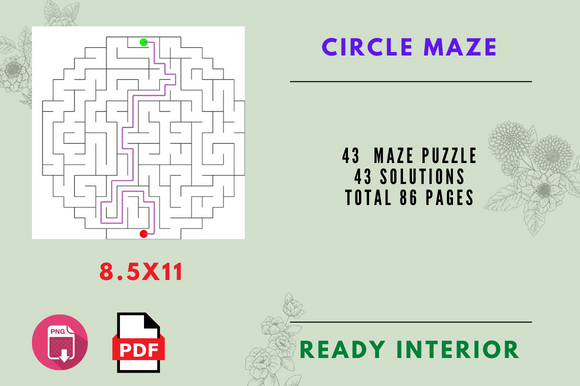
The Art of the Circle Maze: A Timeless Puzzle Reimagined
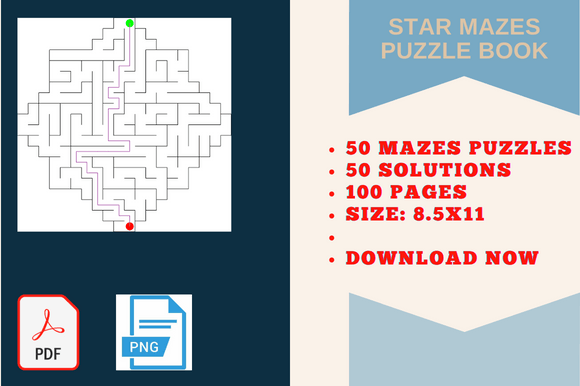
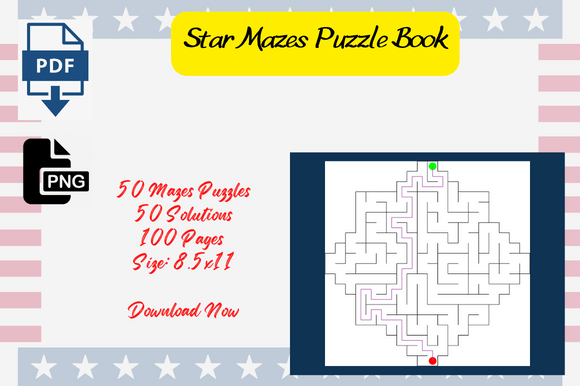
Mazes have captivated humanity for millennia, from the labyrinthine myths of ancient Greece to the hedge puzzles of English gardens. Among this rich history, a specific format has emerged as a uniquely engaging challenge: the circle maze. Unlike traditional square or grid-based mazes, circle mazes present a distinct visual and logical puzzle, winding paths confined within a circular boundary. Today, this classic format is experiencing a renaissance, particularly through dedicated puzzle books like the KDP Interior Star Mazes Puzzle Book, which offers 43 Circle Maze puzzles with solutions in a ready-to-use PDF. But what makes these circular puzzles so special, and why are they more than just a simple diversion?
Understanding the Circle Maze Puzzle
At its core, a maze is a path-finding puzzle with a start point and a goal. The circle maze imposes an elegant geometric constraint on this concept. The entire puzzle—the entry, the winding dead-ends, the correct path, and the exit—is contained within a circle. This fundamental shape changes the puzzle-solving experience in several key ways.
The Visual and Cognitive Appeal
The circular format is inherently pleasing and organized. It provides a clear, contained workspace for your eyes and mind. Unlike sprawling rectangular mazes that can feel endless, a circle maze offers a defined arena. This can reduce initial intimidation and help the solver focus. The paths often radiate from the center or spiral around it, creating patterns that are aesthetically interesting and logically distinct from grid-based intersections. Solving one requires a blend of spatial reasoning, pattern recognition, and sometimes a touch of radial symmetry awareness.
From Confusion to Solution: The Solving Process
Finding the circle maze puzzle solution is a journey of deduction. Beginners often start by tracing obvious paths from the entrance, quickly encountering blocked routes. A more effective strategy is to sometimes work backwards from the exit or to identify "loops" – circular paths that lead back to themselves without progressing. The contained nature of the circle means dead-ends often lead you to the perimeter, forcing you back into the central, more complex web of paths. Each solved maze reinforces critical thinking skills: planning, hypothesis testing (does this path connect?), and persistence.
The Significance of a Dedicated Puzzle Collection
A solitary maze is a fun challenge, but a curated collection, such as a book with 43 mazes in total, represents a structured cognitive exercise. It transforms a casual activity into a progressive skill-building tool.
Purpose and Practical Relevance
Such collections serve multiple purposes in modern life. For the individual, they offer a screen-free, focused mental workout. They are a tool for mindfulness and concentration, pulling attention away from fragmented digital stimuli into a single, absorbing task. In education, maze puzzles are used to develop fine motor skills (when tracing), logical sequencing, and problem-solving patience in children. For adults, they act as a maintenance exercise for cognitive flexibility.
In the context of business and creativity, the process of navigating a maze is a metaphor for project management and innovation. You start with a goal, encounter obstacles (dead-ends), must backtrack and reassess, and finally find a viable route to completion. Engaging with these puzzles can subtly reinforce a mindset adaptable to real-world problem-solving.
The KDP Interior: Accessibility and Ready-to-Use Design
The practical aspect of a KDP Interior ready to upload PDF highlights how classic puzzles fit into today's technology. Kindle Direct Publishing (KDP) allows creators to easily share and distribute digital content. A puzzle book designed as an interior – meaning it's formatted as a complete, print-ready book file – makes this knowledge and entertainment accessible. The specifications of 86 pages, 8.5"x11" with one maze per page, ensure clarity and ease of use, whether printed for physical enjoyment or used on a tablet. Including solutions at the end is crucial, providing closure and learning opportunities. After struggling with a maze, reviewing the correct path teaches the solver about efficient route-finding and often reveals the elegant logic they missed.
Common Misunderstandings and Assumptions
Many people assume mazes are purely for children or are "too easy" for adults. This is a significant misunderstanding. The complexity of a maze is not determined by its format alone but by the density and cleverness of its false paths. A well-designed circle maze can be extraordinarily challenging, with multiple layered loops and deceptive shortcuts. Another assumption is that solving a maze quickly is the only goal. In reality, the process of solving is where the cognitive benefits occur. The frustration of a dead-end and the satisfaction of a discovered connection are the valuable experiences, not the speed.
Furthermore, the term "Star Mazes" in such collections might imply a celestial theme. Often, it refers more to the radial, star-like pattern that paths can create within the circle, not necessarily to literal star shapes. This is a creative design choice that adds visual variety while staying within the circular framework.
Building a Broader Understanding: Mazes in Daily Life and Technology
The principles of maze-solving permeate many areas. Consider navigation apps finding the optimal route through city streets—a real-world, dynamic maze. Or the logic of network routing in technology, where data packets must find a path through connected nodes. Even daily decisions can be seen as mazes: choosing a sequence of tasks to complete a project efficiently involves navigating a maze of dependencies and time constraints.
Engaging with a simple, contained circle maze sharpens the mental muscles used for these complex, real-life navigations. It's a form of cognitive training. The 43 unique puzzles in a collection provide a graduated training ground, often starting with simpler designs and progressing to more intricate ones, allowing the solver to build confidence and skill.
The Role of New Content
The note that all circle maze content is New generate is vital. It ensures freshness and novelty. Solvers are not retreading familiar paths from other books; they are encountering original challenges. This novelty is key to sustained engagement and continued cognitive benefit, as each new maze presents a unique pattern to decode and conquer.
Conclusion: More Than Just a Puzzle
A book of 43 Circle Maze puzzles with solutions is not merely a product. It is a toolkit for mental engagement, a designed journey through the art of problem-solving. From its aesthetically pleasing circular format to its ready-to-use digital interior design, it represents the marriage of a timeless puzzle type with modern accessibility. Whether used for relaxation, education, or cognitive maintenance, these mazes offer a clear, contained space to practice the invaluable skill of finding your way from start to finish, no matter how winding the path may be. In a world full of complex, open-ended problems, the simple, solvable challenge of a circle maze provides a satisfying and profoundly useful escape.