The Big Leap into Math: Why Activity Books and Workbooks Spark a Love for Learning
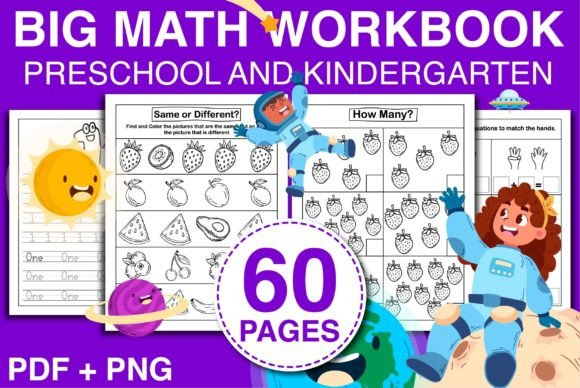
In the exciting journey of early childhood development, few milestones are as fundamental—or as potentially daunting for parents—as introducing a child to mathematics. The words "math workbook" might conjure images of dry, repetitive drills, but today's resources, like comprehensive Big Math Activity and Workbooks for Kids, have transformed this essential learning into a vibrant, playful adventure. This article explores the purpose, significance, and practical magic of these 60-page treasure troves, designed to build confidence and competence from the ground up.
Building Foundations: More Than Just Numbers on a Page
A high-quality math activity book for kids is not merely a collection of problems. It is a structured pathway that guides young learners from curiosity to understanding. Its primary purpose is to develop numeracy—the ability to understand and work with numbers in daily life. This begins with core concepts like number recognition, counting, and simple comparisons, often through engaging visuals and hands-on activities. For a toddler or preschooler, tracing a number or counting colorful butterflies is not a chore; it's a game where the prize is knowledge.
The significance of this early exposure is profound. Research consistently shows that early math skills are a strong predictor of later academic success, not just in mathematics but in reading as well. These pre-school activities lay the neurological groundwork for logical thinking, problem-solving, and pattern recognition. A kindergarten math activity book effectively turns abstract concepts into tangible, manageable tasks, preventing the anxiety that can sometimes accompany math learning later in life.
Deconstructing the Modern Math Activity Book
What makes a resource like a "Big Math Activity and Workbook" stand out? It's the thoughtful integration of several key principles:
- Play-Based Learning: Activities are disguised as play. Matching games, color-by-number, and simple puzzles make learning involuntary and fun.
- Progressive Difficulty: A 60-page book typically starts with basic number identification and gradually introduces addition and subtraction within small number ranges, ensuring the child never feels overwhelmed.
- Multi-Format Accessibility: Offering both PDF and PNG files, as many modern digital resources do, means parents and educators can use the materials flexibly—printing worksheets for hands-on work or using images on tablets for digital interaction.
- Visual Richness: Bright, clear illustrations are not just decorative; they serve as essential learning aids, helping children visualize quantities and mathematical relationships.
From Home to Classroom: The Practical Relevance in Daily Life
The practical relevance of these workbooks extends far beyond the page. They serve as a bridge between formal learning and the mathematics inherent in daily activities. When a child completes a worksheet on addition, they are better equipped to understand that adding one more apple to their basket increases the total. This real-world connection is crucial.
In the modern home, these resources are a tool for engaged parenting. They provide a ready-made, easy-to-use structure for quality learning time, reducing the pressure on parents to invent educational activities from scratch. For homeschoolers or those supplementing school education, a comprehensive math workbook for children acts as a core curriculum component. In classroom settings, teachers use such activity books as supplementary material for differentiated instruction, catering to various learning speeds.
Clarifying Common Misunderstandings
Several assumptions about early math workbooks need addressing:
- “It’s Just Drilling Memorization.” A modern activity book emphasizes conceptual understanding over rote memory. It teaches why 2+3 equals 5 through grouping objects, not just by repeating the fact.
- “It’s Too Formal for Young Kids.” When designed well, these books are age-appropriate. Activities for toddlers and preK involve minimal writing, focusing instead on coloring, matching, and sticking.
- “Digital Files Are Less Effective.” PDF and PNG formats offer incredible versatility. They allow for repeated printing (so a child can practice a favorite page multiple times) and can be used to create custom projects or laminate reusable activity sheets.
The Integrated Learning Journey: How Activity Books Fit a Broader Educational Picture
A math activities book does not exist in isolation. It fits into a holistic approach to early childhood education. It complements:
- Hands-On Manipulatives: Using physical blocks or counters alongside a worksheet page deepens understanding.
- Storybooks: Reading stories that incorporate counting or numbers reinforces concepts in a narrative context.
- Daily Routines: Pairing workbook learning with real-life tasks, like setting the table with a certain number of plates, makes math concrete.
Furthermore, in the context of technology, these printable resources strike a balance. They offer screen-free, tactile learning experiences while still being born from digital creation tools (like those used for KDP interiors), showcasing how traditional and digital worlds can merge to support education.
Examples in Action: Seeing the Natural Learning Process
Imagine a page from a kindergarten activity book focused on subtraction. It might show a picture of five smiling frogs on a log. The instruction asks, “If two frogs jump into the water, how many remain on the log?” The child doesn’t just write ‘3’; they engage with the scene, perhaps circling the frogs that left, and internalize subtraction as a story of removal. Another example for prek math activity could be a simple “Find the Number 4” scavenger hunt across a page filled with various numerals and shapes, turning recognition into an exciting discovery game.
These examples highlight how the activities guide the child to discover mathematical rules naturally, building their own understanding rather than simply receiving information. This method fosters a sense of ownership and achievement, which is critical for developing a positive attitude towards learning.
Choosing and Using a Big Math Resource: A Guide for Parents and Educators
When selecting a math book for kids, look for scope, sequence, and engagement. A 60-page book that covers numbers, counting, shapes, basic addition, and subtraction provides a solid semester’s worth of material. Ensure the progression feels logical. The “easy to use” claim should hold true—the instructions for parents or teachers should be clear and minimal.
To maximize its benefit:
- Follow the Child’s Pace: Don’t rush through pages. Let interest and mastery dictate speed.
- Mix and Match: Alternate a worksheet day with a physical math game day to maintain variety.
- Celebrate Effort, Not Just Correct Answers: Praise the process of thinking and trying, which builds resilience.
Building a Lifelong Relationship with Math
The ultimate goal of a math workbook for kids is not to produce a toddler who can calculate quickly. It is to spark curiosity, build foundational cognitive skills, and instill a belief that math is accessible, fun, and part of their world. By starting with engaging, well-structured resources, we set the stage for a lifetime of logical thinking and problem-solving. The big math activity is, in truth, a small but powerful step towards a future where children view numbers not as obstacles, but as tools for understanding and creating the world around them.
In conclusion, the evolution of the early math activity book into a colorful, progressive, and flexible resource represents a significant advancement in educational support. It aligns perfectly with modern understanding of child development, catering to the needs of boys and girls, children of varied learning styles, and the busy realities of parents and teachers. Whether printed from a PDF or used digitally, these 60-page journeys through numbers are more than just math worksheets; they are invitations to a world of discovery, designed to make the first big leap into math a confident and joyful one.