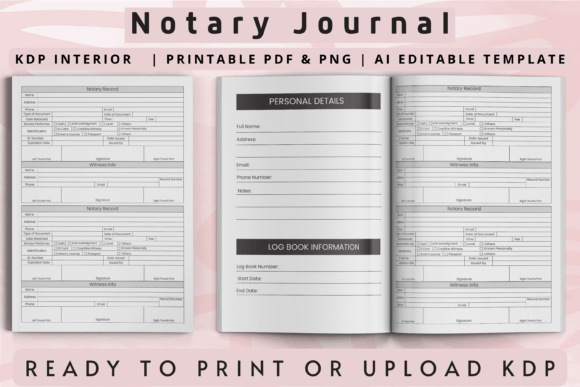
The Notary Journal KDP Interior: A Professional's Essential Record-Keeping Tool
In the world of notary services and signing agents, precision and organization aren't just best practices—they are legal necessities. Every signature witnessed, every document stamped, carries significant weight. The challenge for many professionals, whether seasoned or new to the field, lies in maintaining a flawless, sequential, and easily auditable record of these official acts. This is where a specialized tool like the Notary Journal KDP Interior becomes indispensable. It's not merely a notebook; it's a structured system designed to transform loose records into a bound, professional logbook.
Beyond a Simple Ledger: What This Notary Logbook Provides
A Notary Journal KDP Interior is a pre-formatted, print-ready interior file designed specifically for creating a physical notary journal or logbook. Think of it as the complete blueprint for your record-keeping book. At its core, it provides dedicated pages for personal details and logbook information, structured with clear fields and checkboxes. The 8.5x11 inch dimensions with bleed ensure a standard, professional look when printed, while the high-resolution 300dpi quality guarantees crisp text and clear guidelines on every page. The inclusion of a PowerPoint file allows for minor customization, and the ready-to-upload KDP format means it's optimized for publishing on platforms like Amazon.
But its true value lies in its application. The 110-page count offers ample space for numerous entries, and the high-quality print-ready PDF is tested to ensure no formatting surprises. The design philosophy is practical: easy checkboxes let you instantly see which pages are filled and which are available, eliminating the risk of skipping entries or losing your place. This transforms a reactive task—scribbling details after a signing—into a proactive, streamlined process.
Real-World Scenarios: Who Needs This Journal and Why
The utility of a Notary Journal KDP Interior spans various professionals and situations. For the independent mobile notary, juggling appointments across town, this logbook is a command center. Instead of relying on disparate sticky notes or digital apps that might not meet specific state requirements for physical journals, they have a single, authoritative source. After witnessing a real estate closing at a client's home, they can immediately fill in the sequenced entry, check the box, and have a permanent, unalterable record before they even leave the driveway.
Law firms and corporate legal departments with in-house notaries benefit significantly. It standardizes record-keeping across the organization. Whether notarizing internal affidavits or client powers of attorney, every entry follows the same format, making it effortless for auditors or supervisors to review logs. The professional print-ready output also reflects the firm's commitment to meticulousness.
New Notaries Building Their Practice
For someone just starting their notary business, establishing disciplined habits from day one is crucial. Using a structured Notary Journal KDP Interior from the outset builds that discipline. It removes the uncertainty of "what to record," providing clear fields for dates, document types, signer information, and fees. This not only ensures compliance but also builds confidence. The act of filling a physical journal can feel more official and binding, reinforcing the gravity of the role.
Signing Agents in the Mortgage and Title Industry
Signing agents, who often handle voluminous loan packages, face a high risk of error due to volume and complexity. A logbook with a clear checkbox system acts as a visual audit trail. After a long day with multiple signings, they can quickly verify that every appointment has a corresponding, completed journal entry. This simple visual cue prevents omissions that could lead to serious compliance issues or disputes.
Considering Your Needs Before Using or Choosing a Journal
While the Notary Journal KDP Interior offers a robust template, it's wise to consider a few factors before committing to its use. First, always verify your state's specific regulations regarding notary journals. Some states mandate exact formats or required fields. This interior provides a comprehensive general structure, but you must ensure it aligns with your jurisdictional laws. The included PowerPoint file allows for some adjustment, which can be valuable for adding state-specific headings.
Another consideration is volume. The 110-page count is substantial, but a notary with an exceptionally high volume of daily signings might need a journal with more pages. Conversely, a notary with sporadic activity might find it lasts for years. Think about your workflow: do you prefer a bound book you carry to every signing, or do you transcribe entries later from notes? This journal is ideal for the former, promoting immediate, on-site recording.
A potential limitation to acknowledge is its static nature as a physical log. Unlike some digital databases, it cannot be "searched" electronically. Its strength is in its permanence and sequential integrity, but retrieving a specific entry from months ago requires manually scanning pages. This is a trade-off many professionals accept for the legal solidity and simplicity of a bound book.
The Everyday Benefits: From Chaos to Clarity
Imagine a common scenario: a notary receives a call from a client questioning a notarization from six months prior. With a disorganized system, this could trigger a panicked search through random notes and calendars. With a completed Notary Journal KDP Interior logbook, the notary simply retrieves the bound volume, finds the sequential entry for that date—guided perhaps by the checked boxes—and presents a clear, professional record with all required details. This not only resolves the query efficiently but also protects the notary.
Furthermore, the journal serves as a crucial financial tool. By consistently recording fees in the designated fields, it becomes an automatic ledger for tracking income, simplifying tax preparation and business revenue analysis. It turns a compliance obligation into a business management asset.
For the creative entrepreneur, the KDP-ready aspect opens another door. Beyond personal use, some notaries or designers utilize these professional interiors to create and sell their own branded journals on platforms like Amazon, catering to the wider community of signing professionals. The provided free Amazon keywords are a practical seed for this kind of venture.
In essence, the Notary Journal KDP Interior is more than a product specification list; it's a solution to a universal professional need. It brings order to a critical process, reduces administrative stress, and provides a tangible artifact of one's professional diligence. Whether you're witnessing a single signature a week or managing a bustling signing agency, this tool helps ensure that your official records are as trustworthy and reliable as the service you provide.